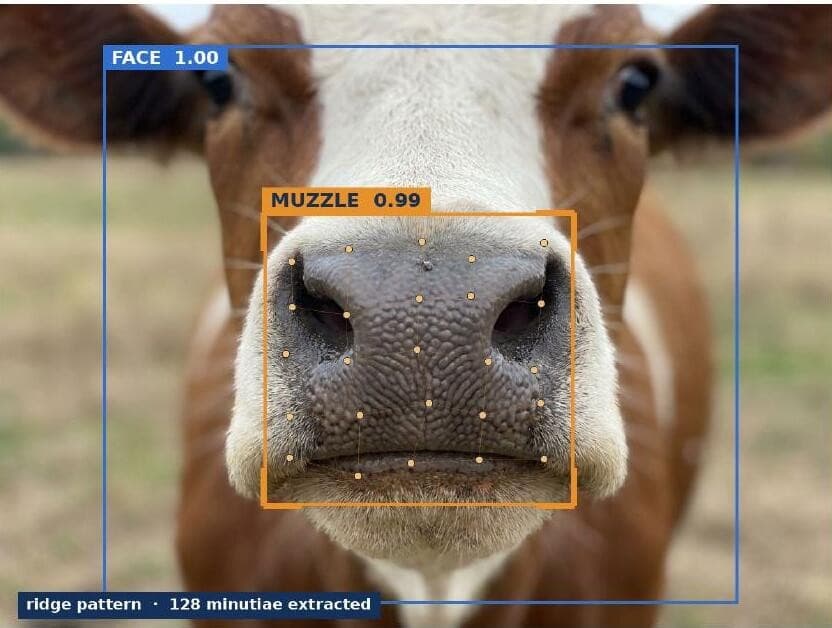
Face & muzzle detection
Locate the animal’s face and isolate the muzzle from smartphone imagery, ready for identity extraction.

Muzzle AI
Muzzle AI is Paceit’s muzzle-based identification platform for cattle and buffaloes. It turns an animal’s distinctive muzzle pattern into a digital identity for connected vaccination, health, breeding and ownership records.
01Ordinary smartphone capture
02Identity linked to existing records
03Recognise the animal at every visit
Vaccination, treatment, breeding and ownership records are only useful when they follow the right animal. A missing tag or duplicate registration can break that connection.
Muzzle AI uses the muzzle’s distinctive pattern as a biometric reference for cattle and buffaloes. Recognise the animal again with a fresh capture, then connect each new service to its existing history.
An identity rooted in the animal. A record that grows with its life.
Muzzle AI is Paceit’s muzzle-based animal identification platform for cattle and buffaloes. It uses computer vision to detect the muzzle, extract a biometric template and compare future captures with enrolled animals. That identity can connect vaccination, veterinary, breeding, ownership and insurance records.
Built by Paceit Labs · Muzzle identification · Cattle and buffalo identity · Connected livestock records
Our detection and matching technology is ready for deployment discussions. We configure enrolment, registry search and repeat identification around your programme, then validate performance on your field data.
Locate the animal’s face and isolate the muzzle from smartphone imagery, ready for identity extraction.
Encode the muzzle’s distinctive ridge and bead pattern as a digital reference linked to the animal’s record.
Compare a fresh capture with a known animal’s enrolled template to check that the record belongs to the animal in front of you.
Search the enrolled register to find a matching animal and flag possible duplicate registrations, including records under different tags.
Link the biometric reference to existing animal IDs and owner records, creating a common identity reference across participating services.
Return a match outcome with confidence. Request recapture or review when image quality or matching evidence is insufficient.
An authorised field worker captures the animal’s muzzle with a smartphone. Guided capture checks focus, lighting and angle.
AI detects the muzzle and extracts a biometric template. A search across enrolled animals checks for a possible existing identity.
Connect the enrolled identity to the animal’s existing tag or registry ID and owner record. Each service can attach its own authorised records.
At a vaccination visit, veterinary consultation, transfer or insurance check, compare a fresh muzzle capture and retrieve the linked animal record.
When capture quality or matching evidence is insufficient, request a fresh image or authorised review before linking a service to a record. Performance is evaluated for the species, age range and capture conditions of each deployment.
Muzzle identification provides the common reference. Connect it to the services your organisation delivers, from a vaccination visit to a change of ownership.
Add biometric verification alongside existing animal IDs. Help field staff identify the animal behind a tag and detect duplicate enrolments across a participating register.
Verify the animal at the point of service, then link the administered dose, date and vaccinator to its record. Connected systems can use that history for due dates and follow-up.
Retrieve the right animal’s treatment, prescription and diagnostic history at each visit, helping maintain continuity of care across authorised providers.
Anchor insemination, calving, pedigree and milk or growth records to a consistent identity, supporting more reliable herd histories.
Verify identity when an animal changes hands or moves between recorded locations. Preserve links to its history through reported transfers and movements.
Use the same identity at policy enrolment and claim time. Matching and supporting evidence help reviewers check whether the claim concerns the insured animal.
Pashu Aadhaar already anchors animal-level services in Bharat Pashudhan. Muzzle AI can be configured to link a muzzle identity to an existing animal ID, with integration subject to system access, permissions and programme requirements.
Read about Bharat Pashudhan’s animal-level records ↗Public programmes, commercial platforms and research point to a broader role for individual animal identity across health, herd management and traceability.
Announced muzzle-ID pilot
A May 2026 report describes a planned muzzle-biometric cattle ID pilot linking vaccination records, health status and insurance, with vaccination reminders envisaged.
The New Indian Express · May 2026 ↗RFID-based livestock platform
The Animal Husbandry Department’s e-Samrudha describes RFID-linked identity for electronic health records, vaccination, breeding and traceability. It illustrates the connected-service use case; its published identity method is RFID.
Kerala Animal Husbandry Department ↗Commercial provider offering
Raiz Brasil describes smartphone muzzle recognition alongside animal histories, vaccinations, weighing and movement records in its livestock management platform.
Raiz Brasil · Product description ↗Published research dataset
Researchers from Nebraska–Lincoln and Iowa State released muzzle images from 268 cattle for individual identification research, supporting work on biometric recognition in livestock management.
Research dataset · 2022 ↗These examples describe the wider ecosystem and research. They are independent of Muzzle AI and do not represent Paceit deployments or partnerships.
Give livestock keepers a more continuous animal history and field teams a consistent way to identify the animal they serve. Start with muzzle enrolment and connect the records that matter to your programme.
Start with identity. Enrol and recognise animals first, then connect vaccination, clinical, breeding or insurance workflows as needed.
Fit the programme. Hosting, access controls, integrations and audit requirements are agreed for each deployment.
Validate by species. Muzzle identity focuses on cattle and buffaloes. Suitability for other livestock is evaluated before biometric use.
Muzzle AI is Paceit’s muzzle-based animal identification platform for cattle and buffaloes. It uses computer vision to detect the muzzle, extract a biometric template and compare future captures with enrolled animals. That identity can connect vaccination, veterinary, breeding, ownership and insurance records.
A field worker captures a clear muzzle image with a smartphone. Muzzle AI locates the muzzle and extracts features from its distinctive ridge and bead pattern. A later capture can be compared with one enrolled animal for verification or searched across the enrolled register for identification.
Muzzle AI is a Paceit platform; Pashu Aadhaar is the animal identification number used in India’s livestock data ecosystem. Muzzle AI can be configured to link a biometric reference to an existing animal ID. Any connection to Bharat Pashudhan or a government registry requires authorised access and an agreed integration.
Muzzle matching helps identify the animal at the vaccination visit. A connected service can then attach the vaccine, administration date and vaccinator to the linked animal record and use that history for follow-up. Identity matching itself does not establish that a vaccination was administered.
A consistent animal identity can support veterinary histories, breeding and calving records, herd management, reported ownership transfers and movement traceability. Insurance enrolment and claim verification are additional applications of the same identity.
Muzzle AI focuses on muzzle identity for cattle and buffaloes. Suitability for other species, age ranges and local capture conditions is evaluated before biometric use is introduced.
Muzzle identity can work alongside existing tags and animal IDs. It recognises an animal when a new image is captured; it does not provide continuous GPS tracking. Official tagging requirements continue to apply to each programme.
Start with a demonstration and a field pilot using representative animals and capture conditions. Enrolment and matching can be configured through a dedicated capture application or integrated into an existing field workflow. Registry access, hosting, permissions and acceptance criteria are agreed for each deployment.
See muzzle detection and matching in a demonstration. Talk to us about an animal identity pilot, a connected livestock register or integration into your existing field application.